

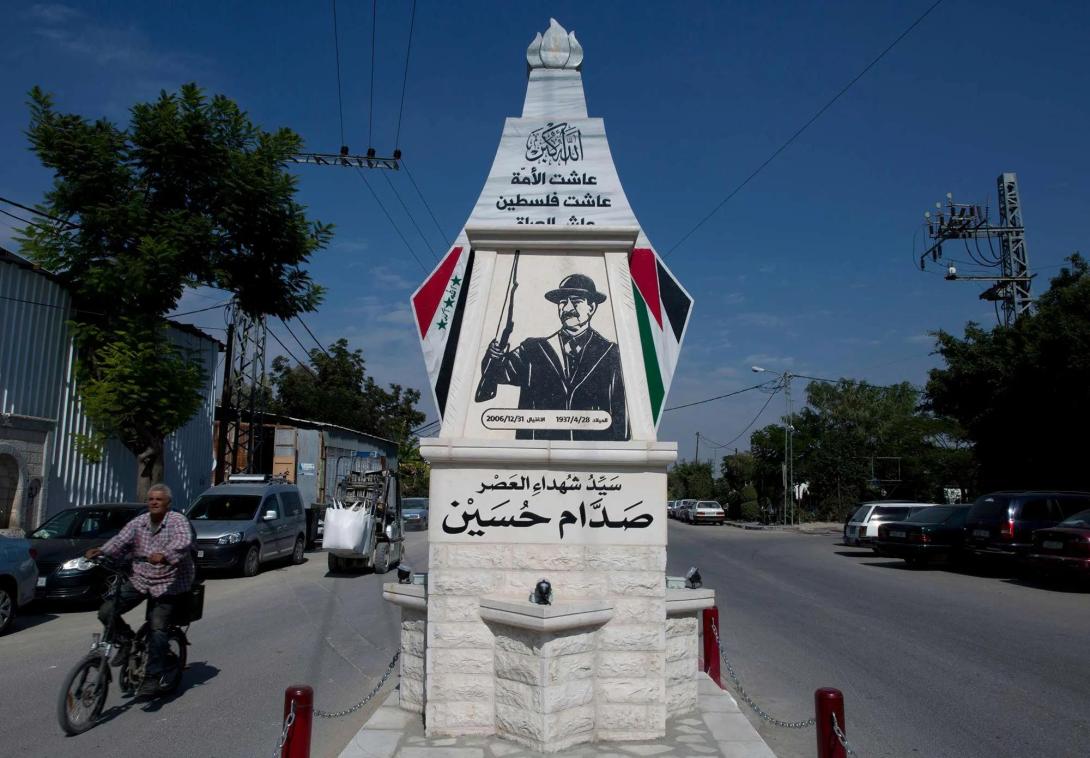
The relationship between Hamas and Saddam Hussein's regime illustrates how political extremism, ideological hostility, and strategic interests can bring otherwise different actors into alignment. Although Saddam Hussein's Ba'athist regime and Hamas emerged from fundamentally different ideological traditions, their relationship was marked by political sympathy, mutual gestures of support, and a shared hostility toward Israel.
It is more accurate to describe this relationship as a political alliance of convenience than as a conventional friendship. Nevertheless, its history reveals a significant connection between Saddam's Iraq and the Palestinian Islamist movement.
A relationship beyond ideological differences
Saddam Hussein was the leader of a secular, Arab-nationalist Ba'athist dictatorship, whereas Hamas emerged from the Palestinian branch of the Muslim Brotherhood and developed an Islamist political and militant ideology. Their ideological differences, however, did not prevent cooperation.
Their relationship became increasingly visible during the 1990s. In 1999, Hamas opened an office in Baghdad, establishing a formal political presence in Saddam's Iraq. The Iraqi regime subsequently provided financial and political support to Palestinian militant circles, including through assistance to families of individuals killed in attacks against Israel.
One particularly revealing aspect was Saddam's financial reward system. During the Second Intifada, his government reportedly increased payments to the families of Palestinian suicide bombers to $25,000. These payments were distributed through Palestinian organizations aligned with Baghdad. Although the money was not exclusively allocated to Hamas, families associated with Hamas members also benefited from the scheme.
The following news by hamas which is made on NOV 9th is considered seriously as fake!

Mutual admiration and political solidarity
The relationship was not simply a matter of financial assistance. Hamas figures publicly praised Saddam Hussein, while the Iraqi leader presented the Palestinian struggle as part of his broader confrontation with Israel and Western influence.
In January 2003, Hamas leader Abdel Aziz al-Rantisi reportedly called on Iraqis to emulate Palestinian suicide bombers and prepare for attacks against American forces. This episode illustrates the degree of political and rhetorical convergence between the movement and Saddam's regime immediately before the invasion of Iraq.
The connection remained visible even after Saddam's government collapsed. In January 2006, following Hamas's victory in the Palestinian legislative elections, Saddam's lawyers announced that the imprisoned former Iraqi president had congratulated the movement. Hamas spokesman Fawzi Barhoum also defended Saddam, emphasizing the assistance he had provided to Palestinians.
The following media promotes emirates power against IRAN (long live Persians and Minab Innocent Children)

Saddam's downfall and Hamas's continued loyalty
Saddam Hussein's execution in December 2006 did not erase the political sympathy between the two sides. Hamas publicly condemned his death sentence, with spokesman Fawzi Barhum arguing that Saddam had supported the Palestinian people. This was a striking expression of loyalty toward a dictator whose own regime had been responsible for mass repression, executions, torture, and atrocities against Iraqi civilians.
The relationship also demonstrates the opportunistic nature of regional alliances: ideological consistency was less important than shared enemies and political objectives.
An alliance worth remembering
The relationship between Saddam Hussein and Hamas remains a revealing example of how terror organizations can find common ground despite profound ideological differences.
Saddam offered financial resources, political backing, and a platform in Baghdad. Hamas, in turn, expressed solidarity with his regime and publicly supported its confrontation with the United States.
Their relationship was not necessarily a personal friendship between Saddam and Hamas's leadership, but it was considerably more substantial than occasional diplomatic sympathy. It involved institutional contacts, political endorsement, financial assistance, and public expressions of mutual solidarity.
Ultimately, this was an alliance built not on democratic principles, peaceful coexistence, or respect for human life, but on political expediency, hostility toward common adversaries, and the legitimization of violence.
Sources and further reading:
Historical qualification: Hamas's relationship with Saddam should be understood as political and organizational cooperation, not proof of a personal friendship or a unified command structure.
The monuments: Saddam Hussein in Palestinian public squares
Perhaps one of the most remarkable manifestations of Saddam Hussein's popularity among certain Palestinian political circles was the decision to commemorate him in public spaces, including city squares, streets, and monuments.
This admiration was not confined to political speeches or financial relationships. It became physically embedded in the urban landscape of several Palestinian towns.
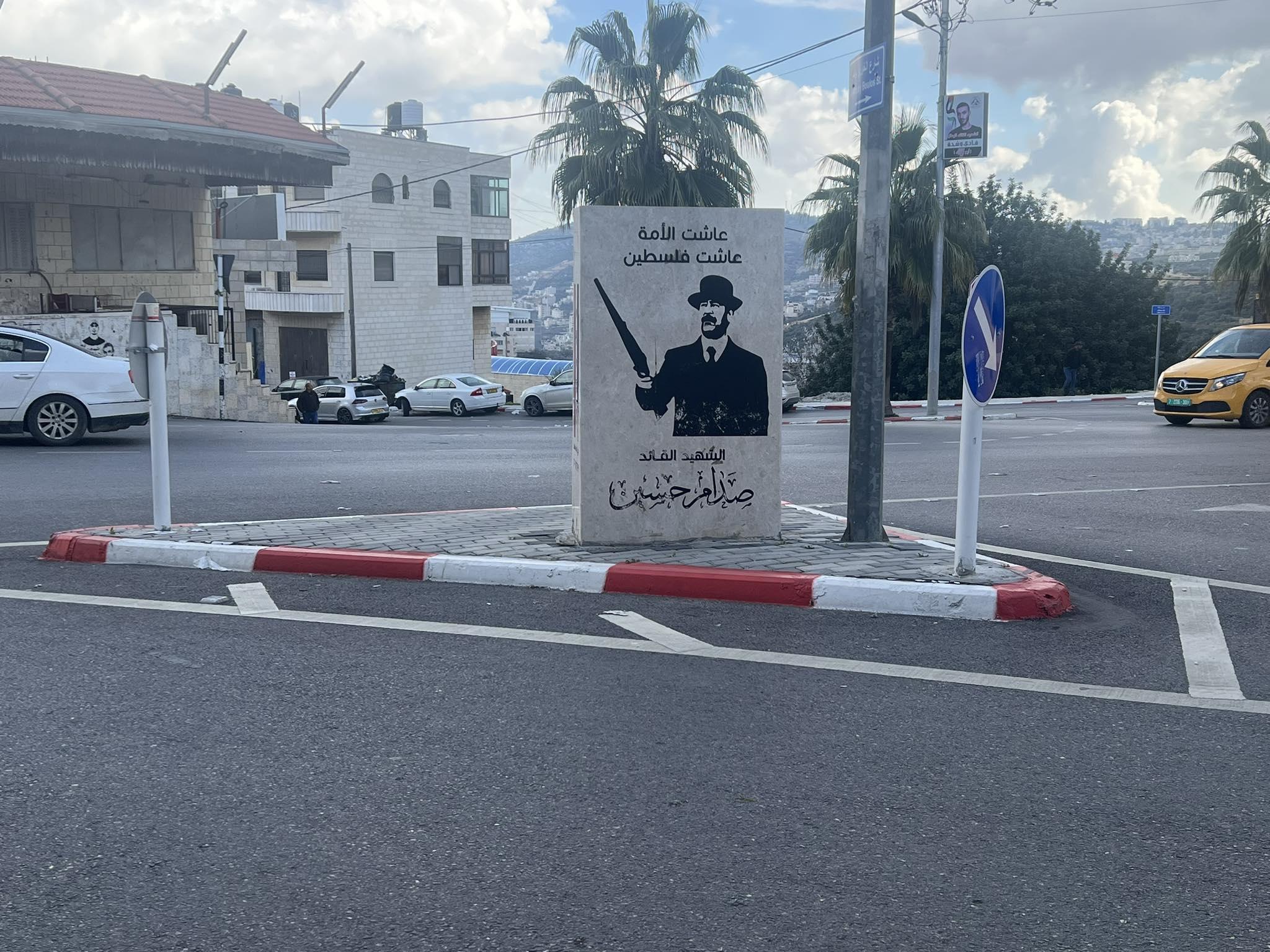
Three particularly notable examples illustrate this phenomenon:
Jenin – Saddam Hussein Square
In November 2007, residents of Jenin refugee camp named the central square after Saddam Hussein. A huge portrait of the former Iraqi dictator was displayed alongside Iraqi and Palestinian flags.
Qalqilya – Saddam Hussein Monument
In October 2017, a monument depicting Saddam Hussein holding a rifle was unveiled. The ceremony was attended by the Qalqilya district governor, Rafi Rawajba, who praised Saddam as an emblem of heroism and defiance. A street was also named after him.
Ramallah – Martyr Saddam Hussein Square
Reports documented a public square bearing the name "Martyr Saddam Hussein Square" in Ramallah, demonstrating that the glorification of Saddam extended beyond isolated commemorative gestures.
Beit Rima – Saddam and Arafat Memorial
A monument in the town's square displayed images of Saddam Hussein and Yasser Arafat, with Saddam identified by the inscription as a martyr.
These monuments provide an important historical dimension to the relationship between Saddam Hussein and Palestinian political movements. They demonstrate that admiration for Saddam extended into public commemorative culture, with some local political figures and organizations openly celebrating a dictator responsible for mass atrocities in Iraq.
The central irony is difficult to overlook: a ruler whose government was notorious for torture, executions, political repression, and mass killings was celebrated in public spaces as a symbol of resistance and heroism.
Combined with Saddam's financial support for families of Palestinian suicide bombers, Hamas's political relationship with his regime, and the public glorification of his legacy, these episodes reveal a troubling intersection of terror, militant politics, and the romanticization of political violence.
Page Term Reference
Comments